Pay With Points at Checkout: What It Actually Costs
Checkout offers you a small piece of free money. The box is right there under the payment options: you have points, and they are worth something, and one click turns a $24.36 order into a $7.10 order.
It is not free money. It is your money, spent at the worst exchange rate the card offers.
What the box actually does
Here is the offer, from a real Amazon checkout.
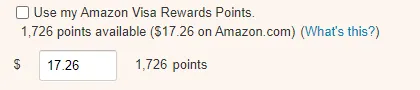
1,726 points, $17.26. One point, one cent — which is the going rate.
Apply them and the order summary does exactly what you would hope.
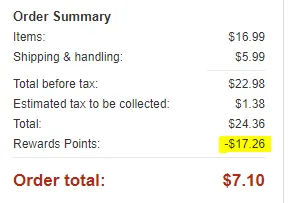
$24.36 becomes $7.10. The rewards line looks like a coupon. It isn’t one.
Behind that line, the bank pays the merchant $17.26 on your behalf and takes 1,726 points off your balance. Your card is charged $7.10 — and a card only earns rewards on what it is charged.
So the $17.26 covered by points earns nothing.
The part that costs you
Say your card pays 2% back. Two ways to buy the same $24.36 order:
Pay with points at checkout. You spend 1,726 points, worth $17.26. Your card is charged $7.10 and earns 14 cents. Out of pocket: $7.10.
Pay with the card, then take the cash back. Your card is charged $24.36 and earns 49 cents. You redeem the same 1,726 points as a $17.26 statement credit. Out of pocket: $7.10 — the same — and you are 35 cents ahead.
Same order, same points, same money out of your account. The difference is whether the purchase was allowed to earn.
Thirty-five cents is not a life-changing sum. That is rather the point: this is not a decision worth agonizing over, it is a default worth setting once. Across a year of a household’s spending, the same leak runs to real money, and it never runs the other way.
The rule: redeem for cash unless the alternative is worth more than a cent per point. Pay with points is never worth more. It is worth exactly a cent, minus what the purchase would have earned.
Where the exceptions live
Some redemptions genuinely beat a cent.
- Travel booked through the card’s own portal often runs 1.25 to 1.5 cents a point. A $300 flight for 20,000 points is 1.5 cents each — that is worth taking over $200 of cash back.
- Transfer partners, on the cards that have them, can beat that again. They can also strand your points in a program you never use. Only count value you will actually redeem.
- Merchandise or software in the rewards catalog, when the thing is something you were going to buy anyway and the catalog price is genuinely below retail. If a $104 annual license goes for 8,500 points, those points did 1.2 cents each — better than the $85 of cash back they were worth, and far better than the $2 you would have earned paying retail.
That last kind is the least reliable of the three. Catalog deals are promotions, and promotions end: the one I used to point people at, a software license through a co-branded card’s rewards store, is gone, along with the card. Check the arithmetic at the moment you are redeeming, not from memory.
The arithmetic is always the same: cents per point = what you get, divided by the points it takes. Anything under a cent is a worse deal than cash. Anything that requires you to buy something you did not want is not a deal at all.
Two things that make it quietly worse
Shopping portals compute their cash back on what you pay. If you route through a cash-back site and then knock $17.26 off with points, the portal sees a $7.10 order and pays you on $7.10. You lose on both sides of the same purchase.
Points do not feel like money, which is the whole design. A balance of 1,726 points does not read as $17.26 the way $17.26 does. That gap is what makes “pay with points” feel like a treat rather than a withdrawal, and it is the same gap that makes a card easier to spend on than cash. The rewards program is not a gift; it is paid for out of interchange fees and, mostly, out of the people who carry a balance.
And if you carry a balance
Then none of this matters yet.
A 2% earn rate against a 25% interest rate is not a strategy, it is a rounding error on the wrong side. One month of interest on a $4,000 balance is about $83. You would need to spend roughly $4,200 to earn that back in rewards.
If that is where you are, the rewards question can wait. Work out what you can actually send at the balance each month, then pick a payoff order and let the points accumulate quietly while you clear it.
What to do this week
- Open your card’s rewards page and find the redemption options. Look for statement credit, ACH transfer to your bank, or a check.
- Check for fees or minimums. They are rare on cash back, but a program that requires 2,500-point blocks changes the arithmetic.
- Set it and leave it. Most issuers let you schedule automatic redemption at a threshold, or on a date. Done once, it never needs deciding again.
- Leave the checkout box alone unless you have run the cents-per-point math and it came out above a cent.
That is the whole discipline. Earn on everything, redeem for cash, and spend the attention you were giving your points on the number that actually moves your finances — what you spent, not what you got back.